


Note: For full disclosure it should be pointed out that Bob is not a licensed or professional dietician nor nutritionist. The advice he is providing in this interview are, simply, his own personal and anecdotal perspectives as an professional athlete. It is always recommended you speak with a licensed professional for a plan that works best for your body and specific conditions.
This article was originally supposed to be published before ADCC Worlds, however as my piece on safety education revealed I went and broke my hand and so here we are several months late.
This is meant to be a complementary piece to Neal H’s excellent podcast episode on weight cutting. He tackles many of the broader controversies around weight cutting in combat sports.

What I wanted to explore here was something slightly different. Specifically, how experience changes the way athletes think about making weight.
This is because of the trend in combat sports being where one person’s personal experience suddenly balloons into a full doctrine others try to replicate.
For example, a random blue belt may cut 15 lbs (~7kg) in a week and win a local competition. Elsewhere someone else spends the night before the competition rotating between a hot bath, a sauna, and questioning their life choices before the event even starts.
Weeks later at the next competition, neither story is treated as a cautionary tale but as a mode of instruction to make weight at the last minute. This can then become the tradition they employ to make weight, which then is passed on as common knowledge amongst their peers, and before long it becomes seen as an irrefutable method that is free from being questioned. I mean it works right? Why look deeper at it?
Nearly everyone in grappling (which includes wrestling, judo, jiu jitsu, and sure we’ll toss MMA into it for good measure) has an opinion on making weight. Far fewer people however can explain why their approach actually works.

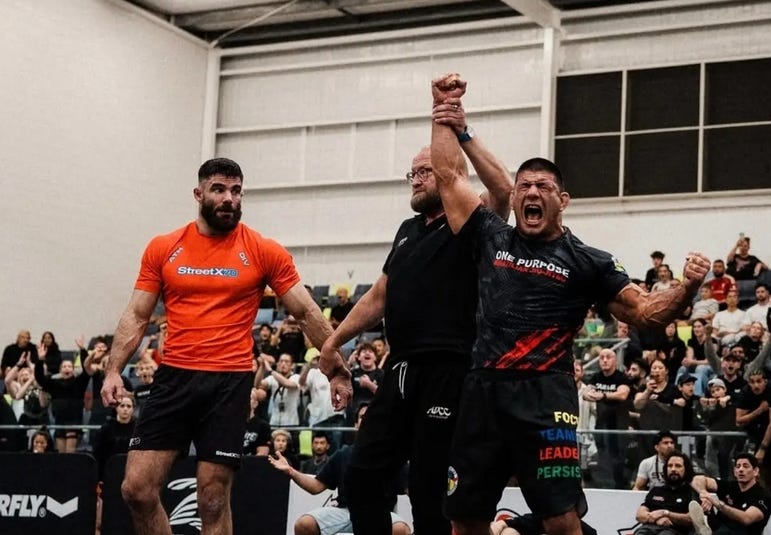
So I went and spoke to someone who could explain why their approach has, consistently, been working for them. I had the chance to chat with Roberto “Bob” Dib Frias a two-time ADCC Trials winner (2022 & 2026) (88kg), the 2024 Abu Dhabi Jiu-Jitsu Master 1 World Champion (94kg), a silver medalist at the 2024 Abu Dhabi Jiu-Jitsu Professional World Championship (94kg)and the 2025 Abu Dhabi Grappling Championship (95kg) winner. Which, as you can see, is quite a series of accomplishments for anyone.
One thing that came up in our discussion was that Bob’s perspective on weight management in 2026 looks very different than the perspective he had earlier in his career.
I think since I got my black belt and probably even earlier, it [weight management] should have been a consideration. I just didn’t worry about it as much because I didn’t have the same understanding about nutrition and how it can refuel your body and help you with recovery.
Which may sound familiar to a lot of jiu jitsu practitioners, especially those who go the competition route.
Most people don’t tend to start combat sports by learning about how good nutrition and management of your diet can help your performance. They tend to purely focus on what the number says on the weigh-in scale. Which is a subtle difference as the latter is focusing purely on a number while the former focuses on the athletes overall ability to perform in competition, which is not always the same thing.
When discussing what has specifically changed over time, Bob points to something that he feels takes many competitors a long time to fully appreciate:
The biggest difference when you do a weigh-in the day before the competition is that you can manipulate a lot of weight without actually dropping calories or dropping body fat. That’s the biggest takeaway I’ve had.
That sounds obvious right up until you realize how many athletes approach making weight as a simple exercise in eating less. In my own experience doing wrestling and jiu jitsu competitions, the common assumption most people default into is fairly straightforward: need to be lighter than you are, no problem just lose whatever weight you can in whatever area. Which, more often than not is not how weight management works. Shocker, I know.
Hydration status of the athlete matters. Glycogen storage matters. Sodium intake matters. The amount of food currently moving through your system matters. The scale is measuring all sorts of things simultaneously, not just one thing.
So, again from my own anecdotal experience, the trend early on in a competitors career is to just do hard cuts (usually via dehydration) to meet the number on the scale you need. Which sometimes results in questioning why your body feels like crap even though you’re supposedly lighter than you were a few days ago.
However, the longer athletes spend competing, the more they tend to discover that weight management is less about finding a miracle trick and more about understanding a system.
Unfortunately, combat sports are also very good at circulating bad information.
Asked about common mistakes, Bob didn’t hesitate.
The most common misguided advice I’ve heard around a lot was to try and do sauna or ice or hot baths for same day weigh-in.
In this perspective what stands out isn’t the specific criticism, it is the broader point being made. Context matters. A recurring theme throughout our conversation was that methods themselves are rarely universally good or universally bad, but what really matters is the situation.
An athlete weighing in the day before competition is dealing with an entirely different problem than an athlete weighing in a few minutes before stepping onto the mat. Which can vary depending on the competition’s format (which is an entirely different discussion topic I want to address at some point).
Treat those situations as identical and things start going sideways fast. This is one of those areas where combat sports culture often works against athletes rather than helps them. As I mentioned earlier, information gets passed around from teammate to teammate or from coach to student and can survive despite being bunk advice because nobody bothered to challenge or question the efficacy of it.
The phrase “that’s how we’ve always done it” has probably done as much damage to nutrition education as it has to every other field of human activity. That becomes especially concerning when younger athletes get involved.
One of the questions I was most interested in asking Bob centered on teenagers and newer competitors attempting to replicate what elite athletes are doing. Not because imitation is inherently bad but because it is remarkably easy to copy behavior without understanding purpose.
Bob’s response was immediate:
There’s lots of risks into not having minimal knowledge. I see a lot of people just going into such a big caloric deficit and that’s very dangerous for their health.
And that observation gets at something bigger than weight cutting. We often see the visible parts of elite performance, but we rarely see the support structure behind it.
More often than note we see what an elite athlete did during the final week before competition (thanks to the prevalence of “Fight Camp Vlogs” on YouTube). What isn’t entirely captured or conveyed is the months of preparation prior to that point. We don’t see the coaching or the nutritional planning (though recently I’ve noticed a bit of an uptick in that area compared to years prior). We also don’t see the accumulated experience that allowed that athlete to make informed decisions in the first place.
As a result, people often imitate actions of their coaches or even “idols” without understanding the reasoning behind why those acts were done in the first place.
It’s the combat sports equivalent of seeing the answer key without seeing the lesson.
The longer we talked, the more obvious it became that Bob wasn’t describing weight management as a collection of secrets and instead he was describing it as a learning process. A fairly standard and mundane learning process, but that’s sometimes all it takes.
Near the end of our discussion, he summarized it in a way I thought was particularly insightful:
The way weight management and weight cutting works nowadays is very different than what most people think it is.
Which I think is true. Many athletes enter the subject expecting to discover some hidden technique or some overlooked shortcut. A secret weapon that their opponent’s won’t be privy to that can give you an edge in performance. But, in reality, they don’t discover anything other than complexity. The more they learn, the more interconnected everything becomes. Performance, nutrition, recovery, hydration, sleep, competition schedules, and training volume all do not exist in isolation from one another.
Which is why Bob’s final piece of advice was refreshingly free of gimmicks:
Seeking knowledge from the right people and the right sources is the best thing anyone should do.
And while that’s not exciting advice, its entirely accurate and valid. Nobody is going to sell a BJJFanatics DVD set called The Ultimate Power of Talking to a Qualified Dietician and Nutritionist. Or, at least most won’t.
And frankly put, again from my own experience as an educator, there are no dramatic training montages associated with intellectual humility (which may speak to a cultural issue within jiu jitsu but that’s a discussion for a different day). After speaking with Bob, I’m increasingly convinced that’s the point.
Combat sports culture loves certainty. It loves the teammate who has an answer for everything. It loves the guy who knows a trick. It loves the story about the athlete who suffered heroically and somehow won anyway.
What it loves considerably less is somebody saying:
“I don’t know. Let’s experiment and work on it until we know for certain.”
Unfortunately, your kidneys do not care how confident the advice sounds.
And if there is a lesson hidden underneath all of this, it may be that experience doesn’t primarily teach athletes how to suffer better.
It teaches them how to think better.
That’s a far less glamorous skill.
It’s also probably the more useful one.