



So first off, I need to apologize. I meant to have the Tap Cancer Out / Jiu Jitsu Charities episode of the Punchsport Pagoda podcast out already. However, a lot of stuff has been happening in my personal and professional life that’s caused a delay in that. I’m working on it but it will be a bit later than I would like.
However, today we are going to talk about a topic I think is worth discussing following the recent community effort to hold gym owners, coaches, and athletes accountable for abuse.
Allegations Against Andre Galvao
If you’re unaware, and I certainly envy you for not being in the thick of this stuff, in early 2026 world champion and Atos Jiu‑Jitsu co‑founder Andre Galvao was directly accused of sexual misconduct and grooming of a minor.
These allegations primarily were brought forward by Alexa Herse, an 18‑year‑old former Atos student who had trained under Galvao since she was a child. Herse provided a detailed statement alleging a six‑month long pattern of inappropriate and escalating behavior by Galvao during training sessions. According to her account, Galvao had been inappropriately touching her, making repeated sexualized comments about her body, and would insist he partner with her despite her attempts to train with other similarly sized athletes.
Herse further alleged that Galvao would regularly make sexualized moaning sounds in her ear when he was in top-mount position and, in one incident, licked her ear while positioned very close to her head. I think this is a good time to point out that Galvao is currently 43 years-old and has known Herse since she was 12 years-old.
Additionally, Herse has accused Galvao’s wife, Angelica Galvao, who is both a black belt and a primary figure in the Atos gym of pressuring Herse into silence. When Herse attempted to raise concerns internally, it is alleged that Angelica told her “if it’s wrong, you have to at least act like it’s right,” in what can only be described as an attempt at discouraging Herse from reporting the misconduct.
Following Herse’s accusations being made publicly, other women stated that they had similar experiences. In response, high‑profile Atos athletes publicly severed ties with the organization. The accusations triggered a broader crisis within Atos, leading the headquarters to announce the immediate removal of both Andre and Angelica Galvao from all leadership and operational roles pending a third‑party investigation. Certainly something an organization does when its founder and leadership are accused of such acts (note: this is sarcasm).
In response, Galvao has publicly denied all claims by calling them fake and that they stem from personal grudges and vendettas. Galvao claimed that Atos maintains constant monitoring and provides a safe environment. He also stated that legal action would be taken to defend his name.
As of writing, no criminal charges have been announced however law enforcement reports were claimed to be filed and both internal and external investigations into Galvao’s conduct are ongoing. This situation has, thankfully, raised urgent questions about safeguarding, coach–student power imbalances, and systemic failures within the sport’s organizational culture.
Duty of Care and Why It Matters
In short, Galvao as the coach and owner of Atos Jiu Jitsu violated key duty he was entrusted to uphold: duty of care. As an educational environment, jiu jitsu gyms are expected to uphold and maintain this key concept. At a structural level, duty of care is the bedrock of a safe learning environment. A standard that is typically expected to be upheld in all learning environments, especially ones that provide educational space to minors (though it equally applies to adults too).
Duty of care is commonly described as the obligation to take reasonable steps to protect students from foreseeable harm, a standard derived from tort principles and widely taught to educators as part of negligence awareness and safety practice. In plain terms, and in the context of martial arts, instructors must anticipate typical risks of training (on and off the mats) and act as a reasonably prudent professional would to minimize those risks for adult and youth athletes alike.
While athletics and sports are not a direct one-to-one comparison with a classroom learning environment at a school, education frameworks provide a clear lens for defining what care looks like in youth-serving environments. The U.S. Department of Education, when they’re not being picked apart by corrupt administrations, serves to centralize federal laws and civil-rights guidance aimed at ensuring safe, nondiscriminatory learning conditions. These frameworks set expectations for institutions to protect students’ welfare and provide avenues to report concerns. A quick reminder, the current U.S. administration wants to shut this department and this sort of service down.
In practice, duty of care translates into competent instruction, adequate supervision, safe facilities, risk management, and clear boundaries—elements emphasized in educator-facing safety guidance and professional standards widely used across not only the U.S. but the world.
In youth sport specifically, the U.S. Congress codified a higher bar through the Protecting Young Victims from Sexual Abuse and Safe Sport Authorization Act of 2017. The Act designates the U.S. Center for SafeSport, who are partnered with the International Brazilian Jiu Jitsu Federation, to set abuse-prevention standards, requires prompt reporting of suspected child abuse, and mandates reasonable procedures to limit one‑on‑one interactions between adults and minor athletes—concrete expressions of duty of care in athletic settings.
SafeSport’s Code and its Minor Athlete Abuse Prevention Policies (MAAPP) lay out these obligations for coaches and clubs by defining prohibited misconduct, education/training requirements, and boundaries in communications and in‑program contact.
A coach’s duty of care is not limited to preventing sexual harm; it extends to injury prevention and medically sound return‑to‑play decisions. The Centers for Disease Control and Prevention’s materials for coaches highlight the expectation to foster a culture of safety, teach risk‑reducing techniques, enforce rules and sportsmanship, and respond appropriately to suspected concussions. Actions squarely within a coach’s duty to protect athletes from foreseeable harm. These resources reinforce that aggressive or unsafe coaching practices increase risk, and that prevention, recognition, and timely referral are part of responsible care.
Particularly for adult athletes, duty of care recognizes autonomy and informed consent while still imposing professional obligations on instructors to avoid reckless training, misuse of authority, or discriminatory treatment, consistent with broader (and sometimes federal) commitment to safe and equitable learning environments. Specifically speaking about the U.S. context, laws and SafeSport policy create heightened safeguards, including mandatory reporting, restricted one‑on‑one contact, and structured supervision measures that jiu jitsu programs can adopt wholesale to meet contemporary expectations.
In short, duty of care in the context of jiu jitsu means building systems that anticipate risk and prevent harm such as through competent age‑appropriate instruction, vigilant supervision, safe spaces and equipment, ethical boundaries in coach–athlete relationships, and transparent reporting pathways. These are not merely best practices; they reflect the standard of care educators and youth‑sport leaders are expected to uphold in the United States.
Similar systems have been established, institutionalized, and enacted in other nations as well. Meaning this is not just a “Only U.S. athletes need to concern themselves with this” and makes it a “everyone in the sport needs to know about these standards” situation.
This Already Exists in the Sport
Within the context of jiu jitsu, the IBJJF explicitly partners with the SafeSport and provides the opportunity for athletes, coaches, and affiliated members to complete SafeSport provided training covering mandatory reporting, sexual misconduct awareness, emotional and physical misconduct, and prevention strategies. In fact, prior to beginning my current stint as a kid’s coach I myself used these programs to ensure I was aware of the standards and policies. It’s also worth noting that as an IBJJF member, you are granted these courses cost-free as the expense is built into your membership.
Additionally, the IBJJF published Coach/Parent Code of Conduct outlines clear behavioral expectations for adults during competitions, including:
Mandatory courtesy toward athletes, referees, parents, and staff
Prohibition of inappropriate language, gestures, or aggressive behavior
Required seated position during matches to limit escalation
Restrictions on physical or verbal interference with officials
These rules help prevent intimidation, emotional abuse, boundary violations, and power‑based misconduct.
For example, with young competitors in the Pee Wee and Mighty Mite divisions (aka the very young kids divisions) the IBJJF restricts access inside barricade areas at competitions to one approved adult. The Junior and Teen divisions simply do not allow coaches inside the barricade space to reduce pressure and potential misconduct. Now, how often this is enforced is ultimately up to the individuals working at the event but systemically it should be regularly enforced even though in practice that’s not always the case.
Similarly, judo has one of the most mature safeguarding frameworks in Olympic combat sports, providing a model for jiu jitsu to follow. The International Judo Federation’s (IJF) Safeguarding Policy defines harassment and abuse, outlines clear reporting pathways, and specifies investigation and disciplinary responses. It places strong emphasis in outlining what is deemed to be psychological, physical, sexual, and neglect‑based harm and establishes the duty to maintain a non‑violent, respectful environment on coaches.
As part of its Sport and Organisation Rules (SOR), the IJF has a dedicated section titled “Policy for Safeguarding Athletes and Other Participants from Harassment and Abuse,” placing safeguarding alongside other core governance elements such as anti‑doping and disciplinary systems. To fulfill this obligation, the IJF maintains a public Abuse and Harassment reporting portal, offering confidentiality, anonymity, and direct access to safeguarding officers. This mechanism helps ensure transparent, accessible reporting and reduces internal suppression of misconduct.
Furthermore, the IJF’s published policies include documents outlining background checks for officials, risk‑assessment procedures, media guidelines and portrayal‑of‑children rules, and mandatory safeguarding education across its continental and national bodies. These in turn help reinforce duty of care practices at every level of competition and administration within the sport.
This is all to say that across grappling, athlete safeguarding has transitioned from the lax and informal “gym culture” to tangible and enforceable codified and established standards.
However, unlike judo there is no single unifying body similar to the IJF or for jiu jitsu. At best, you have the likes of the IBJJF who, while responding to the allegations against Galvao, proscribed no punishment or rebuke of the conduct of a blackbelt they themselves certified under their structure. Meaning a person they were affiliated with, did not lose their affiliation in any meaningful and established way despite facing numerous sexual harassment allegations including that of alleged grooming of a minor. This is, in my own estimation, the sort of inaction that allows for abusive behavior to exist.
These Systems Need to Be Enforced
Duty of care is ultimately tested not by what a sport says in the wake of a slew of allegations or what it writes in its charter, but by who it empowers in practice. When organizations be it the IBJJF or individual coaches/athletes/gyms, through inaction or an unwillingness to proactively police their learning enviroment, allow coaches or high‑status athletes with credible allegations or established histories of misconduct to continue operating, affiliating, or receiving recognition, they do not create a safe environment. Flat out, they in turn create an environment where the victims are told: the status of the accused outweighs the safety of you the victim.
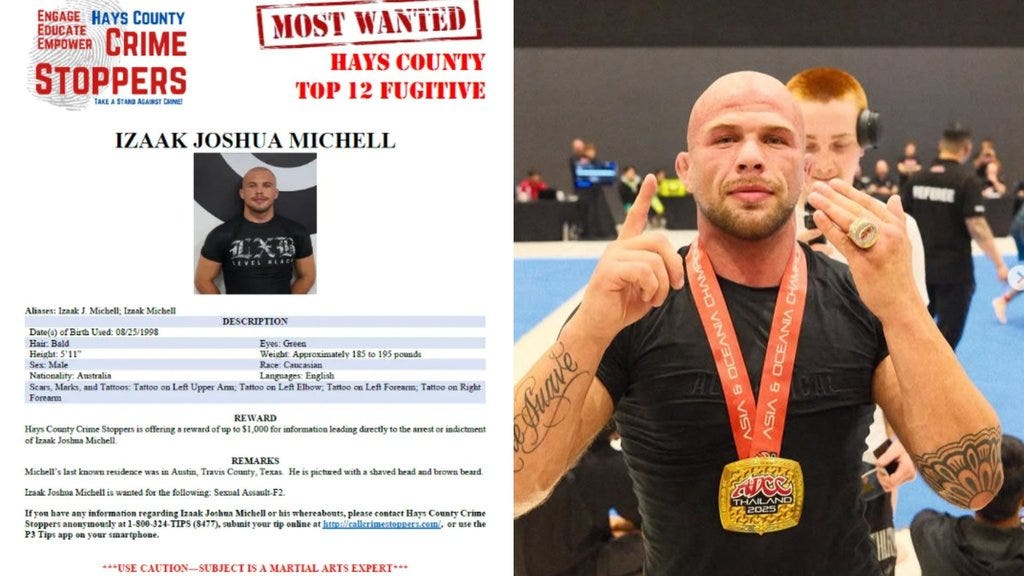
In late 2025, multiple women publicly alleged sexual assault and boundary violations by ADCC veteran Izaak Michell. He was subsequently removed from Gordon Ryan’s gym (Kingsway), which issued cautionary statements to the community. By January, Texas authorities listed him on a “most wanted” notice for a second‑degree sexual assault warrant and urged the public to provide information that would allow them to make an arrest.
Despite those developments, community posts and coverage documented Michell appearing, apparently welcomed or tolerated,in training environments in his home country (where he has not yet been extradited). That dynamic signaled to many women and minors that even serious allegations and an active warrant do not reliably trigger protective measures across the sport’s ecosystem.
For event organizers, gyms, and federations, the duty of care question should be simple: if credible allegations and an active warrant exist, why is any organization exposing athletes, especially minors, to that risk before an independent resolution?
Because jiu jitsu lacks consistent, centralized discipline, signals such as recognition, affiliation, blackbelt status, and seminar visibility carry enormous weight. When high‑status individuals accused of misconduct continue to operate with institutional tolerance, families often interpret this as indifference from the broader sport.
Conversely, interim safeguards such as event suspensions, removal from leadership roles, independent reporting portals are not prejudgments. They are standard risk controls used in many sports while investigations proceed.
Judo, for example, operates under the SafeSport Code and federal law, with a centralized disciplinary and transparency system. Individuals under investigation who pose risk can be temporarily suspended or declared ineligible, often with no‑contact directives. These mechanisms provide rapid, risk‑based protections and make “gym‑hopping” significantly harder—something that repeatedly endangers athletes within jiu jitsu.
This is precisely why jiu jitsu does not simply need a unifying body. What the sport actually, and truly, needs is the organizations that already hold de facto governing power, particularly the IBJJF, to act like one. The IBJJF has unmatched reach, authority, and influence: it sets the standards for rank certification, regulates competition eligibility, and shapes norms for gym affiliation. That makes it the only entity currently positioned to implement universal safeguarding standards, mandate compliance, and publish public sanctions.
In sports governed by the U.S. Center for SafeSport, centralized governing bodies maintain public disciplinary databases, issue interim suspensions, and prevent individuals found responsible—or credibly accused—of misconduct from quietly resurfacing in new environments. These systems show that athlete safety becomes real policy rather than a patchwork of community outrage.
The IBJJF has taken steps to partially meet these standards, like requiring SafeSport training and background checks for black belts seeking certification or renewal. However, the IBJJF has not implemented core protections considered basic in Olympic‑governed sports: cross‑organization bans, public sanction lists, or a transparent disciplinary process. Jiu jitsu may not be pursuing Olympic status, but its global scale and the vulnerability of minors within the sport create the same ethical obligations regardless.
Crucially, the IBJJF already exercises centralized authority when it chooses to. It bans athletes for doping, and while not every organization respects those bans, their very existence demonstrates the IBJJF’s capacity to enforce universal standards. This simply leaves me with the question: why does the IBJJF choose not to in cases of sexual abuse by coaches?
Simply put, Izaak Michell should be barred from participation, affiliation, or recognition across both IBJJF‑connected environments and non-IBJJF environments (eg. ADCC, WNO, UFC BJJ, etc.). He should be persona non grata at minimum until the sexual assault charges he is facing are resolved. Ideally, he’d be barred for life from any and all gyms and competitions. Similarly, at a minimum Andre Galvão should face suspension pending investigation. These are not punitive leaps, they are standard duty of care measures already available and carried out by the IBJJF as mentioned above.
For jiu jitsu to become a truly safe sport, its existing power structures—not hypothetical new ones—must adopt and enforce coherent, centralized safeguards. Athlete protection must not rely on community outrage or informal networks but operate as standing procedures automatically triggered when allegations arise.
Until the sport’s leading organizing bodies actually start enforcing these already established standards upon gyms, coaches, and athletes, we will simply see what Izaak Michell, Andre Galvao, Lloyd Irvin, Marcel Goncalves, Ricardo de la Riva (and many, many others) have allegedly done continue to repeat itself. Ultimately creating an unsafe environment for children, adults, and the sport itself to persist. Something I think nobody in their right mind wants.